



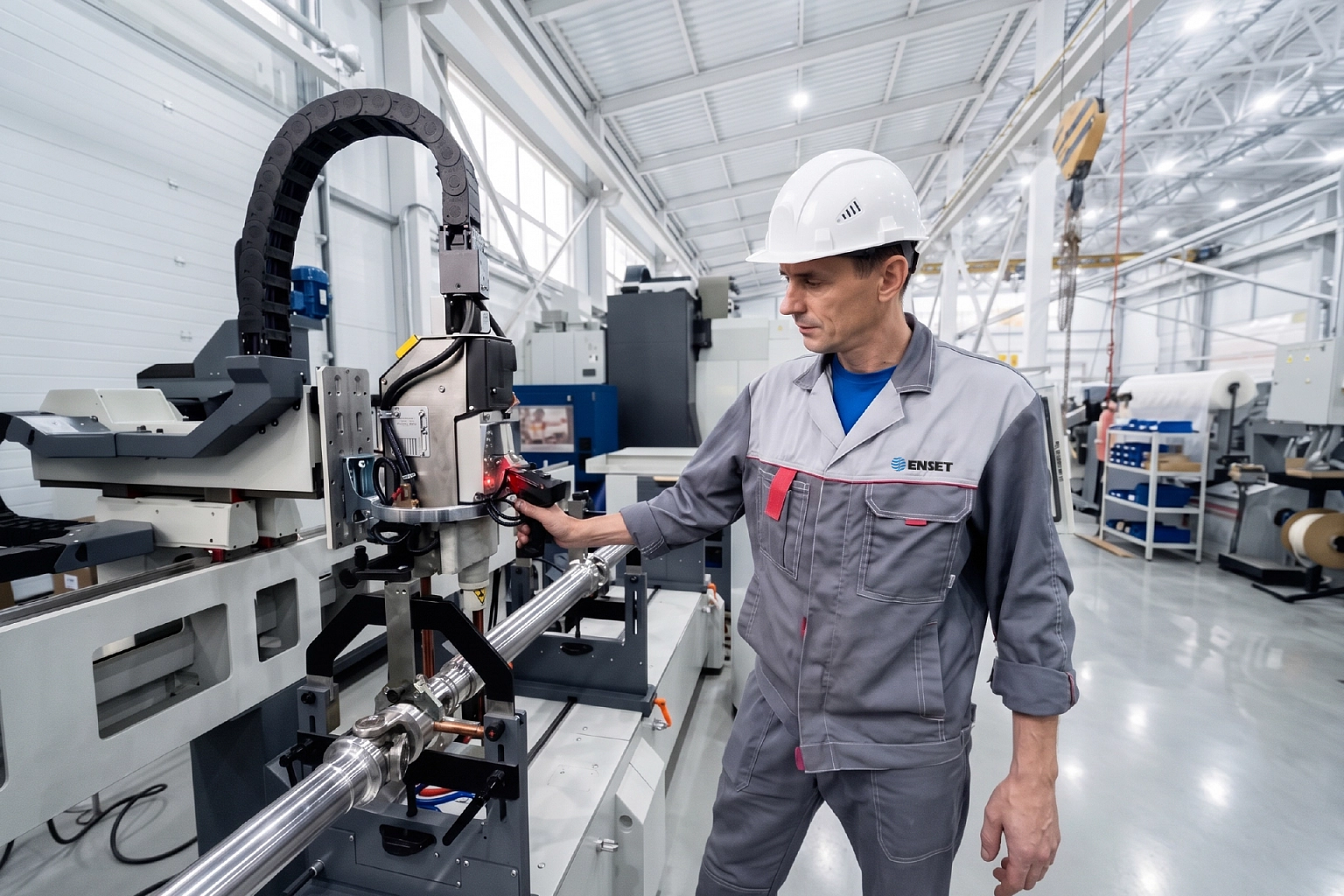
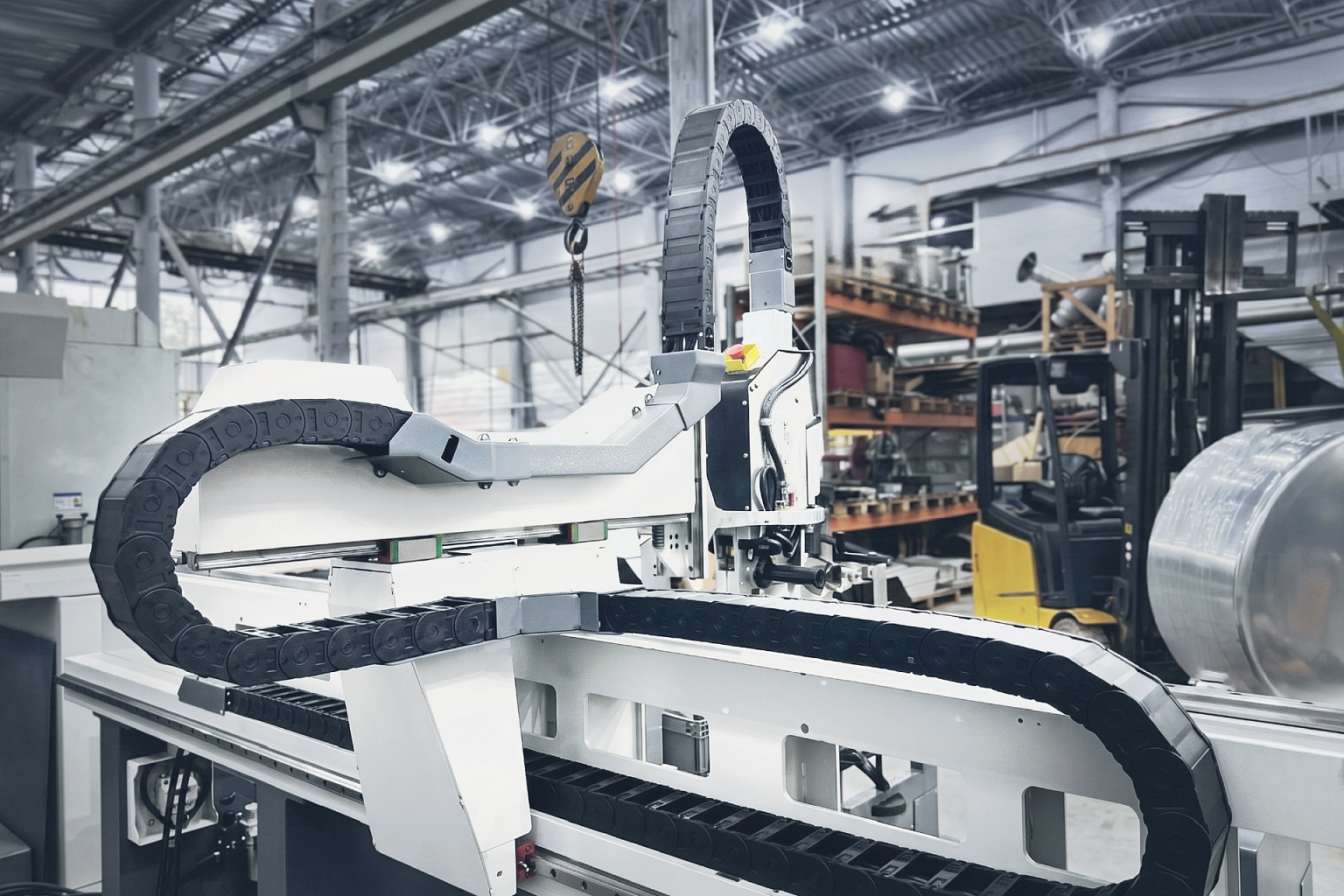
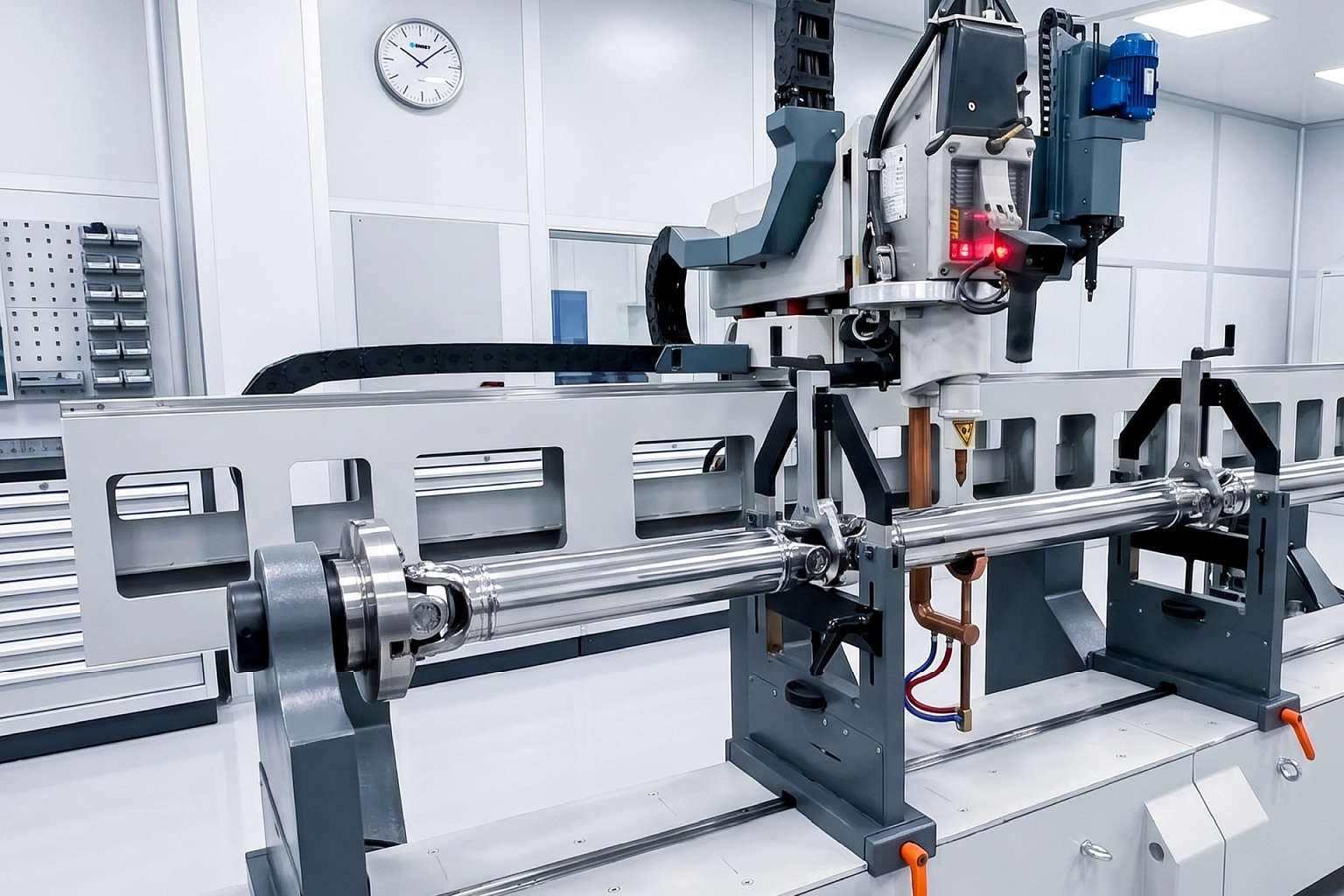
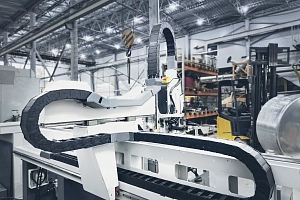
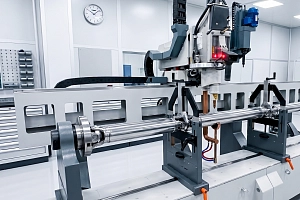
A state-of-the-art balancing system with a spot-welding gantry is being shipped directly from ENSET’s production facility in Rostov-on-Don to a customer in the Republic of Belarus.
The customer specialises in the manufacture and sale of drive shafts for agricultural machinery, road-building equipment, trucks and special-purpose vehicles (BELAZ, UralAZ, MAZ, KAMAZ, GAZ, ZIL, UAZ, PAZ, etc.). Production capacity is up to 15,000 shafts per year.
For an enterprise of this scale, standardising the unbalance correction process and delivering consistent results from batch to batch were the key objectives to be achieved with a multifunctional system in which unbalance measurement and correction are performed in a single set-up.
The DBR CARDAN-300 horizontal hard-bearing balancing machine, equipped with a spot-welding module, is designed for dynamic balancing of multi-support drive shafts weighing from 0.5 to 300 kg and measuring from 170 to 2,737 mm in length. The rigid hard-bearing design of the machine bed, with a cast vibration-damping filling, enables unbalance correction directly on the machine by spot welding, without repositioning the workpiece. The machine is equipped with four supports (two spindle supports and two intermediate adjustable-height supports), a 2 kW servo motor with a rotational speed of up to 4,000 rpm, and automatic rotor indexing to the correction position. No special foundation is required: the system can be installed on any concrete floor, and the electrical equipment is rated IP54.
All unbalance measurement and correction operations are carried out with the shaft in a single set-up, improving not only cycle time but also the quality of the result.
Key production benefits of this system
1. Precise angular positioning of the shaft
The VIBROLAB-5.M measuring system determines the magnitude and angular position of the unbalance. The machine then automatically indexes the shaft to the correction position and holds it there while the balancing weight is welded on. The operator does not need to find the “heavy spot” manually or mark it: the system automatically positions the shaft for correction. The spot-welding gantry secures the balancing plate in the calculated position. This dramatically reduces the risk of exceeding the permissible residual unbalance after correction.
2. Quality of the welded joint
The spot-welding gantry provides controlled electrode clamping force and stable welding parameters. This is fundamentally different from manual arc welding, where the thin wall of the drive-shaft tube can overheat. Overheating can cause warping, geometric distortion and new runout, which then has to be compensated for during balancing. Spot welding localises the heat at the weld point: the tube metal does not overheat and the geometry remains unchanged. The electrode water-cooling system enables long production runs without any reduction in weld quality.
3. Productivity and production flow
When processing identical drive shafts, the spot-welding gantry turns balancing from a bottleneck into a standard part of the production cycle. The welding module is moved manually along linear guideways; a counterbalance mechanism makes height positioning easier.
4. Reduced dependence on operator skill
With manual welding of balancing weights, the result depends more heavily on operator skill and the consistency of the welding parameters. Each of these factors affects the final unbalance. Spot welding via the gantry standardises the process: force, time and position are preset and repeatable. The operator positions the welding tongs and starts the welding cycle. The result is consistent from part to part.
5. Real-time verification
After the balancing weight is welded on, the shaft remains on the same machine. The operator simply starts a measurement, and the system shows whether the unbalance is within tolerance. If not, correction is repeated immediately, without removing the shaft. This is especially important for high-speed shafts, where even a small deviation from the calculated mass of the weight or its angular position can negate the balancing result.
6. Versatility and scalability
The gantry is assembled from 1,500 mm sections and can be fitted to a machine of any length. The range of shaft sizes handled is 30 to 180 mm, with wall thicknesses of 2-12 mm, covering virtually the full range of drive shafts: from passenger cars to trucks and special-purpose vehicles.
Oleg Polushkin, CEO of ENSET LLC:“With the introduction of systems like these, it no longer makes economic sense for our customers to work ‘the old way’, where after every measurement run the operator has to correct the unbalance manually, run the shaft again, and repeat this several times. We have introduced a technology that has not merely improved the balancing and unbalance correction process, but has fundamentally changed the established way of working with shafts: the process itself has changed, the cycle time has been reduced by 30-40%, and both quality and production economics have improved.”
______________________________________________ENSET balancing systems can be equipped with various modules depending on the rotor type and required accuracy:
- Drilling module — for localised mass removal; an electronic depth gauge controls drilling depth to an accuracy of 0.01 mm, and the maximum drilling diameter in steel is 16 mm (CONSOLE, VERTICAL, NEXIS, DBR, BALTRON).
- CNC milling module — for multi-axis polar milling along an arc; used for complex-shaped discs, it provides smoothly distributed material removal without stress concentrations (CONSOLE, VERTICAL).
- Turning and grinding module — can be used for unbalance correction by grinding (ACSIS, FLEXOR).
- Spot-welding module — for welding balancing weights (DBR, BALTRON, NEXIS).
- Laser metal vaporisation and electrochemical machining — for precision applications (PICASSO).
The modules can also be combined: each system is configured for a specific range of parts.
ENSET specialists will help you select the right equipment for balancing and unbalance correction of rotors at your facility. Call: +7 960 442 73 51, +7 (863) 275-80-00 or email: [email protected]